|
Wednesday,
April 17 2007
The
Virginia Tech massacre was a university
shooting that unfolded as two separate attacks, approximately two
hours apart, on Monday, April
16, 2007
on the campus of the Virginia
Polytechnic Institute and State University in Blacksburg, Virginia, United
States. A gunman killed thirty-two people
and injured another twenty-nine before committing suicide,
making it the deadliest mass
shooting in modern U.S.
history.
Cho
Seung-hui, identified by authorities as the gunman, was born in South
Korea and grew up in Northern
Virginia. He had permanent
residence status and was a fourth-year English
major at Virginia Tech.
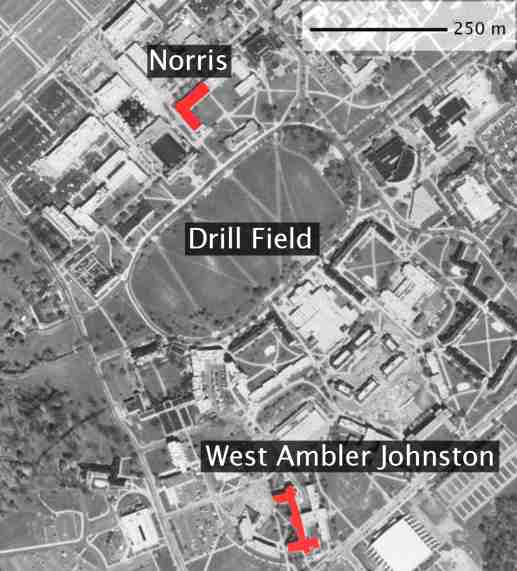
Aerial
photo showing location of Norris and West Ambler Johnston Halls
Attacks
There
were two attacks in two buildings. The first was in the West Ambler
Johnston building, starting at 7:15 a.m., where two died, and the second
at Norris Hall, where 31 died.
West
Ambler Johnston shootings
Authorities
believe that Cho shot his first victims at around 7:15 a.m. EDT
in West
Ambler Johnston Hall, a co-ed dormitory
that houses 895 students. A young woman, Emily
J. Hilscher of Woodville, Virginia,
and a male resident
assistant, Ryan Clark of Martinez, Georgia,
were killed.
Norris
Hall shootings
Approximately
two hours after the initial shootings, shots were reported in a
classroom at Norris
Hall, an engineering and science building that houses the Engineering
Science and Mechanics program. A ballistics
test later showed that the same gun was used in both campus shootings.
An
eyewitness told a Collegiate
Times reporter that a gunman shot about nineteen people
attending a German
class in Norris Hall including the professor.
Only four people emerged unscathed from the German class, with the rest
either killed or wounded. Erin Sheehan, one of the four, said the
shooter "peeked in twice, earlier in the lesson, like he was
looking for someone, somebody, before he started shooting."
Twenty-seven
gunshots can be heard in video footage captured with a cell
phone by student Jamal Albarghouti, later broadcast on many news
outlets.
Student
Nikolas Macko described to BBC
News his experience at the center of the shootings. He had been
attending a math class (near the German class) and heard gunshots in the
hallway. Three people in the classroom barricaded themselves inside the
room using a table. At one point, Macko said, the shooter attempted to
break down the door of the classroom and then shot twice into the room;
one shot hit a podium and the other went out the window. The shooter
reloaded and shot into the door again, but the bullet did not penetrate
into the room. He stated there were "many, many shots" fired.
High
winds prevented emergency
medical services from using helicopters for the evacuations. Victims
injured in the shooting were treated at Montgomery
Regional Hospital in Blacksburg, Carilion
New River Valley Medical Center in Radford, Carilion
Roanoke Memorial Hospital in Roanoke, and Lewis-Gale
Medical Center in Salem.
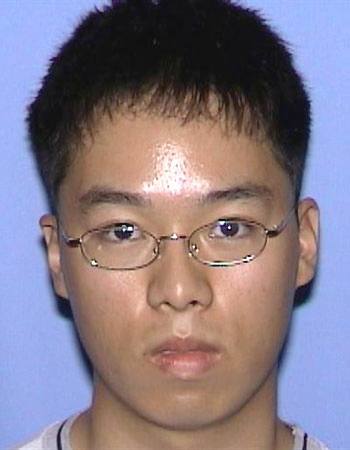
Seung-hui
Cho
Cho
Seung-hui
Background
The
shooter was identified as 23-year-old Cho Seung-hui
(hangul: ),
a South
Korean national living in Virginia
as a permanent
resident. In 1992, at the age of eight, Cho and his family entered
the US through Detroit, Michigan. His current permanent address was
listed as Centreville,
a suburb of Washington,
D.C. in Fairfax
County, Virginia.
He last renewed his green card in 2003. The university reported he was
living in a campus dormitory, Harper Hall, another dormitory just to the
west of West Ambler Johnston Hall dormitory.
He
attended and, in 2003, graduated from Westfield
High School in Chantilly,
Virginia.
Victims Erin Peterson and Reema Samaha graduated from Westfield in 2006,
but it is not known if Cho knew either of them.
He was an undergraduate student in his senior year, majoring in English.
A spokesman for Virginia Tech has described him as a "loner,"
stating that the University was having difficulty finding information
about him.
Blacksburg police confirm Cho was investigated in late 2005 in
connection with stalking
complaints, but no prosecution resulted.
Possible
motives
Cho's
motives for the killings remain unclear. Early
reports suggested that the killing was the result of a domestic dispute
between Cho and previously alleged girlfriend Emily
Hilscher, who was later revealed to have had no prior relationship
with Cho.
When
police investigated Cho's dorm, they found a paper describing how his
life was hell and his plan of suicide. In it he laid out a list of
grievances including "rich kids" or "debauchery"
and "deceitful charlatans"
on campus. Another sentence in the paper read "you caused me to do
this."
The words "Ismail Ax" were found written on his arm in red
ink, although a later report gave the spelling as "Ismale Ax"
and stated that the words were tattooed on his arm.
In the package of information that Cho sent to NBC, he wrote his
sender's name as "A. Ishmail".
Lucinda
Roy, Cho's former creative
writing professor says she was disturbed by the student's behavior
and writing to the point of warning campus police and other officials
about him, but was told they could not do much as no direct threat was
involved, and they did not wish to violate his rights of free
speech.
Roy told ABC
News that Cho seemed "extraordinarily lonely — the
loneliest person I have ever met in my life." She said he always
wore sunglasses and a cap inside, spoke in a whisper, and took cell
phone pictures of her. Deeply concerned, she arranged to work one-on-one
with Cho, and asked him to go to counseling, but he apparently never
went.
Professor
Nikki
Giovanni told CNN about Cho's writing, "It was not bad poetry.
It was intimidating... there was something mean about this boy. It was
the meanness — I've taught troubled youngsters and crazy people — it
was the meanness that bothered me. It was a really mean streak."
Professor
Giovanni insisted that Cho be removed from her class in 2005 because he
had intimidated other students by photographing them and by writing
obscene, violent poetry. "I was willing to resign before I would
continue with him," she said.
University
officials said the school had obtained a "temporary detention
order" from a local magistrate that allowed them to refer Cho to an
off-campus medical facility. Based on the complaints of his two female
classmates that indicated they had received threatening messages from
him. Cho was admitted to Carilion St. Albans Psychiatric Hospital in
December 2005. According to Virginia law, "A magistrate has the
authority to issue a detention order upon a finding that a person is
mentally ill and in need of hospitalization or treatment. "The
magistrate also must find that the person is an imminent danger to
himself or others," says the guideline from Virginia's state court
system.
Shortly
after Cho's identification as a suspect, a copy of a play by Cho
entitled "Richard McBeef" began circulating online. The short
play deals with topics of molestation and violence involving chainsaws,
and ends with the title character delivering "a deadly blow"
to his thirteen-year-old stepson.
Cho also wrote a second play, entitled "Mr. Brownstone"; the
play is named after a Guns
N' Roses song
and contains lyrics copied verbatim from the song.
An
unnamed professor who taught Cho characterized his work as "very
adolescent" and "silly," with attempts at "slapstick
comedy" and "elements of violence."
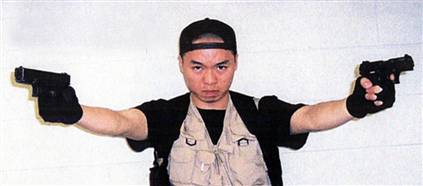
Photograph
taken by Cho Seung-hui
Preparation
Officials
believe he used a 9
mm Glock
19 and a .22
caliber Walther
P22 handgun.
Cho purchased his first gun, the .22 caliber Walther P22 on February
9, 2007
at a pawnbroker
in Blacksburg.
On March
13, 2007,
Cho purchased a second handgun, a semiautomatic 9 mm Glock 19, at
Roanoke Firearms.
In Virginia, permanent legal residents of the United States who are 21
years of age or older are eligible to purchase handguns provided they
have not been convicted of any felonies or have other disqualifications.
Both guns were found with their serial numbers filed off, a felony
offense, federal law enforcement officials said. The owner of Roanoke
Firearms was reported to have been 'devastated' when he heard news that
one of his weapons was used in the incident.
According to former FBI agent Brad Garrett, "This was no spur of
the moment crime. He's been thinking about this for several months prior
to the shooting."
It
is not known what, if any, previous firearm experience or training Cho
had completed before the massacre. It is not known where or how Cho
obtained the chain with which he locked the doors at the stairway in the
engineering classroom building.
At
9:01 a.m. EDT,
after the first shooting and before the second, Cho mailed a timestamped
package to NBC containing dozens of images of him with weapons, a 1,800
word manifesto and some 23 video clips in which he alludes to the
killings saying “You had a hundred billion chances and ways to have
avoided today.” and '“I didn’t have to do this. I could have left.
I could have fled. But no, I will no longer run. It’s not for me. For
my children, for my brothers and sisters that you fuck — I did it for
them”. It is not known if he was referring to the shootings prior to
committing them or if he had already killed Emily Hilscher and Ryan
Clark.
One
of the guns was used in both incidents. An official added that Cho was
"heavily armed and wearing a vest."
Shooter's
message to NBC News
On
April
18, NBC News received a package from Cho timestamped between the
first two shootings and the rest of the massacre two hours later. It
contained an 1,800-word manifesto, pictures,
and 23 videos. In the videos, sent in QuickTime format, Cho discussed
his religion and his hatred of the wealthy. He also said in one of the
videos, "You had a hundred billion chances and ways to have avoided
today...But you decided to spill my blood. You forced me into a corner
and gave me only one option. The decision was yours. Now you have blood
on your hands that will never wash off."
Copycat
Several
copy-cat threats have been received, including those at:
Victims
- West
Ambler Johnston Hall Dormitory (first shooting)
- Norris
Hall Engineering Building (second shooting)
- Students
-
Ross
Abdallah Alameddine
-
Brian
Bluhm
-
Austin
Cloyd
-
Matthew
Gwaltney
-
Caitlin
Hammaren
-
Jeremy
Herbstritt
-
Rachael
Elizabeth Hill
-
Matthew
La Porte
-
Jarrett
Lane
|
|
-
Julia
Pryde
-
Mary
Karen Read
-
Reema
Joseph Samaha
-
Waleed
Shaalan
-
Leslie
Sherman
-
Maxine
Turner
-
Nicole
White
|
- Faculty
-
Christopher
James Bishop
-
Jocelyne
Couture-Nowak
|
-
Kevin
Granata
-
Liviu
Librescu
|
|
Timeline
- Responses
to the incidents
University
response
Virginia
Tech cancelled classes for the rest of the week and closed Norris Hall
for the remainder of the semester. The University is offering counseling
assistance for students and faculty and held an assembly on Tuesday, April
17, 2007.
Additionally, the Red
Cross has dispatched several dozen crisis counselors to Blacksburg
to help Virginia Tech students cope with the tragedy.
Virginia
Tech President Charles
Steger stated at the first news conference that authorities
initially believed the first shooting at the West Ambler Johnston
dormitory was a domestic dispute and that the shooter had left campus.
Steger
indicated in a second press conference at around 5pm EDT on the day of
the attack that several thousand students were already on their way to
class:
|
"
|
You
have to remember that of the 26,000 [students] that we have,
over 9,000 are on campus. When the classes start at 8:00 A.M.,
thousands of people are in transit. The question is, where do
you keep them where it is most safe? We concluded that the
incident at the dormitory was domestic in nature. These other
events occurred two hours later.
|
"
|
Steger
further noted:
|
"
|
It
is very difficult, because we are an open society and an open
campus. We have 26,000 people here. The best thing that we can
do is to have people report anything that they saw that was
suspicious. We obviously cannot have an armed guard in front of
every classroom every day of the year. …What we try to
determine is are they kept out of harm’s way by staying in the
dorms or staying in the academic buildings. We send out
communications by e-mail, we have an emergency alert system to
get the word to our students as quickly as we can. With 11,000
people driving in to campus, it is extremely difficult if not
impossible to get the word out instantaneously.
|
"
|
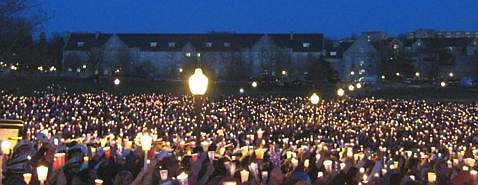
Virginia
Tech students mourn their fallen friends at a candlelight vigil
Criticism
of university response
Some
students, parents, and commentators in the media blamed the University,
saying that administrators should have done more to notify others and
lock down the campus immediately.
Authorities
identified a "person of interest" in the first shooting, Karl
Thornhill, who was Emily Hilscher's boyfriend. Hilscher's roommate,
Heather Haugh, told authorities that Thornhill owned firearms and had
taken both girls to a shooting range. Thornhill was pulled over while
leaving Tech's campus after the first shooting, and made authorities
suspicious by contradicting Haugh's account. Because authorities quickly
apprehended him, they determined that the threat of further violence was
minimal and consequently did not justify additional action by the
University. However, as they were questioning Mr. Thornhill, reports of
widespread shooting at Norris Hall came in, suggesting that the threat
had not been contained. Thornhill has subsequently been released, but
remains an important witness in the case, according to police.
At
an afternoon news conference, Governor Timothy
Kaine of Virginia indicated that Charles
Steger (the president of Virginia Tech) had asked him to appoint a
committee to examine the university's response to the shootings and help
answer any remaining questions. In an interview with CNN, Governor Kaine
indicated that W. Gerald Massengill, former superintendent of Virginia
State Police, would conduct the review.
Student
response
Some
Virginia Tech students questioned why the University had not been locked
down after the first shooting. After becoming aware of the incident,
students communicated with their family and peers about their
conditions, using telephones or social
networking websites
such as Facebook
or MySpace.
Many students created Facebook memorial pages for some of their fellow
students. Fearing retribution from other students, Kim Min-kyung, a
South Korean student at Virginia Tech, said South Korean students were
gathering in groups "as it could be dangerous."
Lee
Seung-wook, head of Virginia Tech's Korean Student Association, said
"I am worried about possible racial prejudices that this horrible
incident may bring to Asians, especially Koreans".
Law
enforcement response
After
the second attack, the Virginia Tech Police, along with the Blacksburg
Police Department, Montgomery
County Sheriff's Office and the Virginia
State Police immediately responded following their active
shooter protocols. Local SWAT
teams were activated and responded. In addition to the Virginia Tech
campus police, the Federal
Bureau of Investigation has joined the investigation. Bureau
spokesman Richard Kolko stated there was no immediate evidence to
suggest a terrorist incident, but that the agency is exploring all
avenues. The Virginia
State Police are also investigating. The Bureau
of Alcohol, Tobacco, Firearms and Explosives (ATF) immediately
responded to the incident with 10 agents on-scene identifying the
weapons and performing forensics.
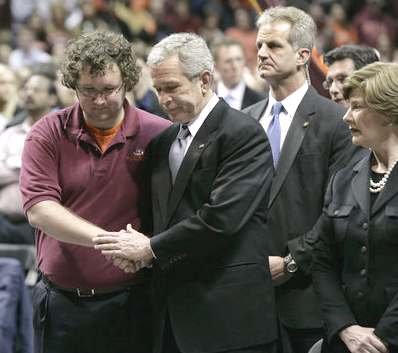
President
George
W. Bush shakes the hand of the Virginia Tech Student
Government Association's President James Tyger
following his
speech at the school's convocation
Government
response
Virginia's
U.S. Senators John
Warner and Jim
Webb have both offered their condolences. Virginia Governor Tim
Kaine returned early from a trip to Tokyo,
Japan
and declared a "state
of emergency" in Virginia, allowing the governor to immediately
deploy state personnel, equipment, and other resources to help out in
the aftermath of a tragedy.
On
Monday, the U.S.
House of Representatives and the Senate
observed a moment
of silence in remembrance of the victims. The Senate also approved a
resolution on Monday night extending condolences to the victims of the
shooting. Senate
Judiciary Committee chairman Patrick
Leahy postponed by two days the scheduled April
17, 2007
testimony of Attorney
General Alberto
Gonzales concerning the
firings of eight United States prosecutors.
In a statement, Gonzales said that the Justice
Department would provide support and assistance to the local
authorities and victims as long as they were needed.
Immediately
following the news of the tragedy, White House spokesman said President George
W. Bush was horrified by the rampage and offered his prayers
to the victims and the people of Virginia. In response to questioning,
Deputy White House Press Secretary Dana
Perino said, "The president believes that there is a
right for people to bear arms, but that all laws must be
followed." Bush also stated that the nation was "shocked and
saddened" by the shooting. He added that "schools should be
places of safety and sanctuary and learning. When that sanctuary is
violated, the impact is felt in every American classroom and every
American community." He also pledged assistance to law enforcement
and the local community. President Bush and his wife Laura also attended
the convocation at Virginia Tech on Tuesday. Bush ordered the White
House flag lowered to half
staff and requested all flags be so lowered until sundown on Sunday, April
22, 2007.
The
Internal
Revenue Service and Virginia Department of Taxation are granting six
month extensions to individuals affected by the massacre. The extensions
are "available to shooting victims and their families, emergency
responders, Tech students and university employees."
Other
schools' responses
There
have been official responses from many universities, both inside of the
United States and abroad, regarding the massacre, reflecting widespread
public horror and concern, expressing shock, sympathy, and condolences
to the Virginia Tech community.
Florida
State University Vice President for Student Affairs Mary Coburn
released an email on April 17th, stating that the university, in
response to the Virginia Tech massacre, had instituted an emergency
cellular phone contact plan via text message, in the event of a similar
situation. Florida State University president T.
K. Wetherell issued a statement of condolence, in which he outlined
the university's disaster response plans in a similar situation. Florida
State University is a sister ACC
institution of Virginia Tech.
The
Ohio State University President Karen
A. Holbrook released a statement that is linked from the
university's homepage since the day of the shootings and that was sent
out in a campuswide email to students and faculty on Wednesday, April
18, 2007 shortly before campus cable networks began practicing new
emergency broadcast tests. She asserts that "Ohio State stands
ready to provide any assistance to Virginia Tech that they may identify
in the days to come."
Furthermore, OSU police released information on their preparedness for
dealing with similar situations that featured local news coverage and
front page newspaper coverage.
The
University
of Virginia has offered psychological support services and medical
assistance to the victims and afflicted at Virginia Tech Radford
University is providing free temporary housing for the Virginia
State Police officers investigating the incident.
In
response to the death of Wake
Forest University faculty member Kevin Granata and the injury of
faculty director Wally Grant at Virginia Tech in the joint Virginia
Tech-Wake Forest University School of Biomedical Engineering and
Sciences, Wake Forest has offered physical assistance, and has sent
grief counselors including Professor Samuel Gladding, chairman of WFU's
counseling department. Clemson
University, a sister ACC land grant school, to Virginia Tech,
released a statement stating that they were offering grief counseling
from their counseling center to Virginia Tech, as well as other offers
of assistance. Georgia
Tech, Virginia Tech's sister polytechnic institution, released a
statement from president Wayne
Clough, a prior Virginia Tech faculty dean. The statement noted that
Clough once was Dean of Engineering at Virginia Tech and held an office
in Norris hall; he offered any requested assistance to Virginia Tech
president Steger.
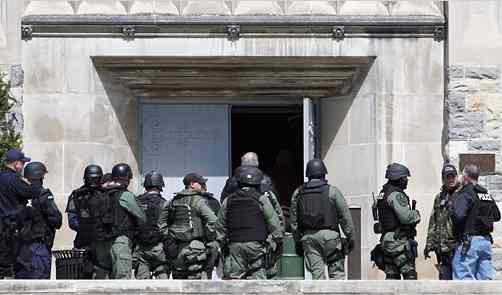
Virginia Tech
Special Weapons Tactical unit
Sporting
tributes
The
Washington Nationals, during their April 17, 2007 game against the
Atlanta Braves, wore Virginia Tech baseball caps in memory of the
victims.
International
reaction
There
was a widespread international response, including condolences and
sympathy from many countries including officials in Australia,
Canada,
People's
Republic of China, France,
Germany,
India, Iran,
Japan, Mexico,
Pakistan,
the Philippines,
and the UK,
as well as from Pope Benedict
XVI. The Secretary-General of the United
Nations and former South Korean foreign minister Ban Ki-moon also offered condolences, condemning the massacre as
"rampant killing of innocent citizens and children".
Australian
Prime Minister John Howard said in response to the killings that
"America's gun culture was costing lives."
In
the Republic
of Korea, President Roh
Moo-hyun expressed his deepest condolences, saying, "I was so
shocked and it was so unthinkable, and I would like to express, on
behalf of South Korean people, our deep condolences to the families of
the innocent victims and to those who were injured" right after the
Virginia news. After the further news that the killer was identified as
a South Korean student, he again expressed South Koreans' sincerest
condolences on Tuesday night (Korean time) to the victims and to their
families, and to all US citizens. Their foreign
minister, Song
Min-soon, also mentioned that safety measures have been established
for Koreans living in the US. He appeared to be referring to the
possibility of reprisal attacks against Korean communities within the
United States. A ministry official also stated that he hoped the
shooting would not "stir up racial prejudice or
confrontation."
On
April the 18th, President Traian
Băsescu of Romania
posthumously conferred the national honor The
Star of Romania with the rank of Grand Cross on Professor Liviu
Librescu, as "a sign of high appreciation and gratitude for the
entire scientific and academic activity, as well as for the heroism
shown in the course of the tragic events which took place on April the
16th, 2007, in the Campus of Virginia Polytechnic Institute and State
University, Blacksburg, the United States of America, through which he
saved the lives of his students, sacrificing his own life."
On
April 18, 2007, China said it was regrettable that some
US media reports were quick to blame a Chinese student for the
Virginia Tech massacre. “Some US media made irresponsible reports on
the Virginia Tech shooting before finding out the truth, which violated
their professional ethics,” Foreign Ministry spokesman Liu Jianchao
said, according to Xinhua News Agency.
On
April 17th, Canadian
Prime Minister Stephen
Harper spoke in the Canadian
House of Commons: "We learned that a Canadian is among the
victims in Virginia and Mr. Speaker,
I can say that the prayers, thoughts and condolences of each and every
one one us here in the House are with that family," the prime
minister said in French. “It’s really almost impossible to
comprehend why an individual would take his own life and that of so many
others in this way but I think we can all say that our thoughts are with
all of the victims, their family and the community,” he continued in
English. Liberal
leader Stephane
Dion expressed condolences. Deputy Liberal leader Michael
Ignatieff said, "We extend our sympathy to the families and
loved ones of those who lost their lives and to the students and staff
of the university whose lives have been altered forever by this tragedy.
For those who have been injured, we offer sincere wishes for a swift
recovery." New
Democratic Party leader Jack
Layton expressed condolences to Canadian victim Jocelyne
Couture-Nowak as well as the families of the other victims.
Historical
context
The
incident is the deadliest shooting on a college campus, exceeding the
sixteen deaths of the University of Texas shooting by Charles Whitman in
1966. It is the second deadliest school-related killing in U.S. history,
behind the 1927 Bath School disaster which claimed forty-five lives,
including thirty-eight school children, through the use of explosives.
With
a death toll of thirty-two victims plus the killer, this is the
deadliest single-perpetrator civilian shooting in United States history,
surpassing the Luby's massacre of 1991, in which twenty-four people were
killed. Internationally, it is surpassed by the 1982 massacre of
fifty-seven South Koreans by off-duty police officer Woo Bum-Kon and the
1996 Port Arthur massacre in the Australian state of Tasmania where
thirty-five people were killed by gunman Martin Bryant.
The
shooting has been likened to the Columbine High School massacre, the
April 20, 1999 school massacre in which two senior students killed
twelve students, one teacher, and wounded twenty-four others before
turning the guns on themselves.
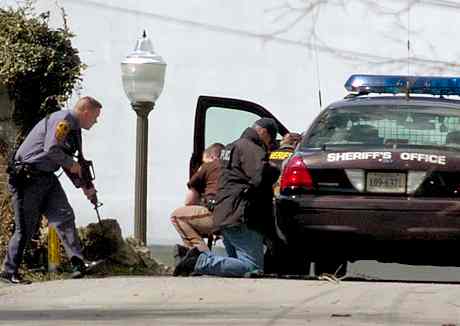
Virginia Tech shooting massacre
Sheriff's Office in action
Untruthful
media reports
Chicago
Sun-Times columnist Michael Sneed reported several hours after the
incident that the shooter "was a Chinese national who arrived in
the United States last year on a student visa" and "arrived in
San Francisco on a United Airlines flight on Aug. 7, 2006, on a visa
issued in Shanghai",
a claim which was widely used by media, including FOX News, MSNBC, ABC
News, sina and sohu, and one that turned out to be false and was later
removed unceremoniously by Chicago Sun-Times, but not before websites
that carried these stories were temporarily blocked by the PRC governmen.
Gun
control debate
The
massacre reignited the gun control debate in the United States, with
proponents of anti-gun legislation claiming guns are too accessible (and
hence Cho readily acquired them) and proponents of gun rights and the
Second Amendment claiming guns are not accessible enough (and hence none
of Cho's victims were armed in the gun-free "safe zone", so
none of them were able to defend themselves from his attacks). Note that
the much-debated federal Gun-Free School Zones Act of 1990 is not an
issue in this incident; that law applies only to elementary and
secondary schools, not to colleges and universities.
Background
Law
enforcement officials have described finding a purchase receipt for at
least one of the guns used in the assault and note that permanent
residents in Virginia may legally purchase firearms with proof of
residency; in addition, federal law requires a criminal background check
for handgun purchases from licensed firearms dealers. Virginia has a law
limiting purchases of handguns to one every 30 days. The shooter had
apparently waited one month after buying his .22 caliber before he
bought his second gun, a Glock 19.
Virginia
Tech has a policy forbidding unauthorized possession or storage of
firearms on campus, even by state licensed concealed weapons permit
holders. This policy has been challenged in recent years. In April of
2005, a student licensed by the Commonwealth of Virginia to carry
concealed weapons was discovered possessing a concealed firearm in
class. While no criminal charges were filed, it is unknown whether
disciplinary action was taken by the school for violating Tech policy
due to student confidentiality.
University
spokesman Larry Hincker, in response to challenges over the authority of
the university to enforce such a policy, said "We think we have the
right to adhere to and enforce that policy because, in the end, we think
it's a common-sense policy for the protection of students, staff and
faculty as well as guests and visitors."
Virginia
bill HB 1572, intended to prohibit public universities from making
"rules or regulations limiting or abridging the ability of a
student who possesses a valid concealed handgun permit … from lawfully
carrying a concealed handgun" was introduced into the Virginia
House of Representatives by delegate Todd Gilbert. The university
opposed the bill, which died in subcommittee in January of 2006.
Spokesman Larry Hincker responded "I'm sure the university
community is appreciative of the General Assembly's actions because this
will help parents, students, faculty and visitors feel safe on our
campus."
Prior
to the shootings, Bradford B. Wiles, a graduate student at Virginia
Tech, published an editorial in 2006 in the Roanoke Times calling
for a change in Virginia Tech's policy prohibiting the carrying of
licensed firearms.
Media
response
The
response to how gun control affected the massacre was predominantly
split—while some believe the university's ban on students carrying
concealed weapons contributed to the massacre as students were unable to
defend themselves against the perpetrator, others believe that the
United States', and Virginia's, relatively liberal gun control laws
allowed the gunman to purchase the guns and ammunition that allowed the
shootings to take place.
The
Brady
Campaign to Prevent Gun Violence, an American gun
control group, said that it was easy for an individual to get
powerful weapons and called for "common-sense actions to prevent
tragedies like this from continuing to occur". The
New York Times ran an editorial calling for more gun control:
"Yesterday’s mass shooting at Virginia Tech—the worst in
American history—is another horrifying reminder that some of the
gravest dangers Americans face come from killers at home armed with guns
that are frighteningly easy to obtain."
On
the other side of the issue, the Conservative Voice contrasted
the Virginia Tech massacre with the Appalachian
School of Law shooting in 2002, when a disgruntled student killed
two students before he was subdued by two other students with personal
firearms they had retrieved from their vehicles, declaring that
"All the school shootings that have ended abruptly in the last ten
years were stopped because a law-abiding citizen—a potential
victim—had a gun."
The
Washington Post described both sides of the gun control debate
in an editorial, asking how and when the shooter obtained his weapons,
but also asking if the tragedy would have occurred if Virginia law did
not prohibit the carrying of lawfully concealed weapons on college
campuses. After reviewing recent U.S. history regarding shootings, The
Economist magazine concluded, "The Columbine
killings of 1999 failed to provoke any shift in Americans’
attitudes to guns. There is no reason to believe that this massacre, or
the next one, will do so either."
Virginia
Governor Tim
Kaine condemned this debate in the press and elsewhere as occurring
at an inappropriate time. "People who want to take this within 24
hours of the event and use it as a political hobbyhorse — I only have
loathing for them," Gov. Kaine said during an evening press
conference on April 17, 2007. "To those who want to make this into
some sort of crusade, I say take this elsewhere."
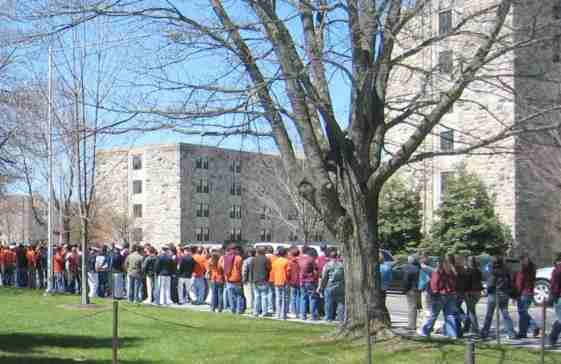
Virginia Tech shooting massacre students outside university halls
References
-
Front
page. Virginia Tech official website.
-
"Gunman
killed after deadly Virginia Tech rampage", CNN.
-
Norris
Hall gunman identified; ballistics match at both crime scenes.
Virginia Polytechnic Institute and State University.
-
VA.
Tech Readies To Honor Dead. Clickondetroit.com.
-
Brendan
Bush. "At
least 32 dead in Virginia shooting rampage", Reuters.
-
John
M. Broder. "Virginia
Gunman Identified as a Student", New
York Times.
-
Ned
Potter, David Schoetz, et al. Killer's
Note: 'You Caused Me to Do This'. ABC News.
-
John
M. Broder. "32
Shot Dead on Virginia Tech Campus", The New York Times,
April 17, 2007.
-
"First
shooting victim name as Ryan Clark", Daily Mail, Associated
Newspapers.
-
"US
university shooting kills 33", BBC.
-
Tom
Regan. "Norris
Hall shooter identified", NPR,
April 17, 2007
-
"German
Teacher Killed at Virginia Massacre", Ajc, 2007-04-16.
-
"Professor
among victims of Virginia Tech Massacre", Los
Angeles Times
-
"Students
react to the tragedy", Collegiate
Times.
-
"Virginia
Tech Shooting Video Online: 33 Killed, 29 Injured", Post
Chronicle
-
Holley,
Joe. "Students
Recount Shootings.", Washington
Post.
-
"Rampage
Strains Area Hospitals", Washington
Post.
-
"Campus
gunman lived in US since 1992 – official".
-
"Killer's
Note: 'You Caused Me to Do This'".
-
David
Schoetz, Ned Potter, and Richard Esposito; Killer's
Note: 'You Caused Me to Do This'
-
"Shop
owner: Virginia Tech shooter bought gun for $571", CNN.
-
"Victims
in Virginia Tech Massacre", MSNBC.
-
Va.
Tech: Gunman Student From S. Korea
-
"Va.
killer had contact with police before attack", MSNBC.
-
Baron,
Mike "Virginia
Tech Shooting: Cho Seung-Hui Suicide Note Found" Post
Chronicle, retrieved on.
-
Sources:
College gunman left note", Chicago
Tribune
-
[1]",
Washington
Post
-
http://www.msnbc.msn.com/id/18183171/displaymode/1107/s/2/framenumber/2/
-
"Kaine
Seeks Independent Review of Officials Response", Washington
Post
-
Killer's
Note: 'You Caused Me to Do This'", ABC News
-
Adam
Geller. "Va.
gunman had 2 past stalking cases", Houston Chronicle,
April 18, 2007.
-
http://news.yahoo.com/s/nm/20070418/us_nm/usa_crime_shooting_dc
-
http://abcnews.go.com/US/story?id=3052278&page=1
-
Killer
spent time in mental health unit (The Times)
-
Virginia
Killer's Violent Writings: Play told of pedophilic stepfather,
murder of 13-year-old boy, The Smoking Gun
-
Cho
Seung-Hui's Plays, AOL News
-
Pat
Wingert, Lynn Waddell and Arian Campo-Flores. "He
Was Just Off", Newsweek
-
First
Gun Bought March 13; No 'Spur of the Moment' Crime
-
MSNBC.com
-
Gun
Used In Rampage Traced To Roanoke Shop. CBS Broadcasting Inc..
-
Campus
Gunman Lived in U.S. 14 Years
-
"First
Gun Bought March 13; No 'Spur of the Moment' Crime".
-
Va.
Tech gunman sent material to NBC
-
"31
Dead In Virginia Tech Shooting", CBS
11.
-
Fantz,
Ashley, O'Connor, Anahad. "Virginia
Tech Shooting Kills at Least 33", New York Times.
-
"ABC
News Massacre at Virginia Tech: 33 Confirmed Dead", ABC.
-
"At
least 33 dead in rampage at Virginia college", MSNBC.
-
Gunman
sent package to NBC News. MSNBC.com.
-
http://www.odu.edu/webroot/orgs/IA/university_news.nsf/articles/04182007054159PM
-
http://www.wdsu.com/news/12279015/detail.html
-
http://www.walledlake.k12.mi.us/wlwhs
-
http://www.wctrib.com/ap/index.cfm?page=view&id=D8OJ71QO1&forumcomm_check_return
-
http://kutv.com/local/local_story_108155139.html
-
http://blog.nj.com/ledgerupdates/2007/04/north_brunswick_high_locked_do.html
-
http://www.9news.com/news/article.aspx?storyid=68319
-
Broder,
John. "32
Shot Dead on Virginia Tech Campus", New York Times.
-
Coroner
confirms student’s death, The Roanoke Times
-
Fox
News. Victims
of Virginia Tech Shooting.
-
VATech.
Deans'
Forum on the Environment.
-
List
of confirmed deceased. Collegiate
Times.
-
Victims
in Virginia Tech massacre – MSNBC.com. MSNBC.
-
Bellefonte
Grad Killed in Virginia Tech Shootings.
-
"Police:
Virginia Tech shooter an English major, 23", CNN
-
"Indonesian
student among the victims of Virginia Tech massacre".
-
Indonesian
among the dead in U.S. campus massacre.
-
"Virginia
Tech's missing Indian student dead", CNN-IBN
-
"ALERT:
Lincoln student among Virginia Tech victims", The
Providence Journal
-
Wolfy
Becker. Peruvian
student among the victims in Virginia Tech massacre. Journal
Peru.
-
Virginia
shootings: The Victims. BBC.
-
http://www.people.com/people/article/0,,20035456,00.html
-
Greg
Livadas. "Student,
19, with relatives here among the victims", Democrat and
Chronicle
-
"Virginia
Tech victims", Herald Sun.
-
"Professor
among Virginia Tech victims", Los Angeles Times.
-
"Quebecer
among 32 Virginia Tech victims", CBC
News.
-
Donovan,
Doug. "'I
don't think my teacher got out'", Baltimore Sun.
-
Holocaust
survivor among those killed Daily Herald Retrieved on
4/18/07
-
http://www.cee.vt.edu/people/loganathan.html
-
Kurz,
Jr., Hank. "Questions
Raised on Va. Tech Security." Washington
Post, Associated
Press report.
-
Critical
Questions Linger on Virginia Tech Campus ABC News; April 16,
2007.
-
Virginia
Tech Massacre: Out of a nightmare, The Santa Fe New Mexican,
April 18, 2007.
-
Gunman
Kills 32 at Virginia Tech In Deadliest Shooting in U.S. History.
The
Washington Post.
-
Shaila
Dewan and John M. Broder. "Two-Hour Delay Is Linked to Bad
Lead", The New York Times, April 18, 2007.
-
Between
Virginia shootings, police chased a false lead; International
Herald Tribune; April 18, 2007.
-
"Virginia
Tech Shooting Press Conference: 33 Dead, Anger, Questions",
Post Chronicle.
-
Fox
News. Virginia
Tech Campus Reels From Shooting That Leaves at Least 32 Dead.
-
http://www.msnbc.msn.com/id/18158063/
-
Korea
Fears Prejudice with Shooting Link, from breitbart.com
-
[3]
Korean student named gunman in U.S. massacre, JoongAng Daily
-
The
Red and Black, University of Georgia. University
students express shock in response to slayings at Va. Tech.
-
My
Fox Washington DC. Bush
Calls Virginia Tech Shooting 'Terrible Tragedy'.
-
KWTX
News. Visibly
Shaken Virginia Senator Says Shootings Have Touched The Nation.
-
Governor
declares state of emergency The
Associated Press
-
"President
Bush says shootings at Virginia Tech affect all students",
WHDH-TV
-
Gonzales
hearing postponed, SFGate.com
-
Gonzales
offers support, CBS
News
-
Press
Briefing by Dana Perino
-
Sue
Lindsey, AP writer. Gunman
kills 32 in Virginia Tech rampage.
-
Bush
statement on VT shootings, White
House
-
Riechman,
Deb. "Bush
to Speak at Virginia Tech Service", Forbes
-
Day
of mourning declared as Cho's stalking revealed, The Roanoke
Times, 12:41 PM April 18th, 2007.
-
Statement
from President Casteen on Events at Virginia Tech.
-
SFA
response regarding Virginia Tech events.
-
note
registration required, Text from email: "In the wake of the
tragedy that occurred at our sister ACC institution, Virginia Tech,
FSU asks each student immediately to follow the web link below in
order to record your mobile phone number. FSU will use this number
only in extreme emergency to send text messages directly to you.
Please help FSU be able to inform you immediately of circumstances
where the safety of campus locations is in question.
-
FSU
statement
-
"Though
no campus community can be completely protected from such a crime,
Florida State University constantly plans for just such events and
has put into place seven proactive law enforcement programs to
reinforce the safety of our university's students, faculty, staff
and visitors."
-
"Statement
by Karen A. Holbrook on the Tragedy at Virginia Tech"
-
Tim
Hoffins, "OSU police prepared if shooting occurs," The
Lantern 118 (Tuesday, April 17, 2007): 1
-
http://www.virginia.edu/vatechsupport/
-
http://www.virginia.edu/uvatoday/newsRelease.php?id=1882
-
http://www.radford.edu/ruannouncement041607.html
-
http://www2.wfubmc.edu/graduate/VT.ApplegateStmt.html
-
http://www.wfu.edu/president/2007.04.16.php
-
http://www.clemson.edu/clemson-vt/
-
http://www.gatech.edu/news-room/release.php?id=1341
-
"Nationals
show support by sporting Virginia Tech caps", Associated
Press
-
Doorstop
Interview – Lowood Show Hall – Lowood, Prime Minister of
Australia Homepage,
-
"Harper
expresses condolences to the families of the victims",
-
"39th
Parliament, 1st Session, Edited Hansard • Number 133"
-
Xinhua
News Agency
-
France
3.
-
[4]
-
[5]
-
"Iran
condemns Virginia shooting", Ministry of foreign affairs, Islamic
Republic of Iran,
-
Virginia
governor, in Japan, says it's too early to blame school in shooting
rampage, Mainichi Daily News
-
"Mexico
condemns Virginia shootings"
-
"Musharraf
grieved over US varsity carnage", The News
-
"Arroyo
expresses condolence over tragedy in Virginia Tech University"
-
"Blair's
'sadness' at US shootings", BBC News
-
Virginia
Tech massacre "senseless tragedy" - Pope, Malaysia
Star,
-
"Korea
fears prejudice with shooting link", Yahoo,
-
http://news.xinhuanet.com/english/2007-04/18/content_5992194.htm
-
Jae-Soon
Chang. "KGunman's
family had hard life in Korea", Chron.com,
. (in English)
-
"'총기
난사' 범인,
한국교포학생
23세
조승희 (The
killer is Cho Seung-hui, a South Korean)",
Chosunilbo,
(in Korean)
-
"Seoul
expresses shock as gunman identified as Korean",
ChannelNewsAsia.com,
-
"Korea
Fears Prejudice With Shooting Link", Associated Press
via Breitbart.com,
-
Official
decree of The Romanian Presidency
-
Michael
Sneed's irresponsible report
-
http://www.canada.com/victoriatimescolonist/story
-
These
totals includes the murderer or murderers. In the University of
Texas shooting, different sources claim fifteen, sixteen or
seventeen victim deaths. In the Bath disaster, forty-four were
killed by the bombs, with the killer's wife beaten to death earlier.
-
Editorial.
The Recorder. Central Connecticut State University.
-
"Gunman
ID'd as student; tests tie same gun to both attacks", New
York Newsday.
-
"Shooter
Identified as Cho Seung-Hui", ABC News.
-
Code
of Virginia, §18.2-308.2:2(P)
(2005).
-
"Shooter
had guns more than 1 month before Va. shootings", WDBJ-TV.
-
Virginia
Tech's ban on guns may draw legal fire
-
Gun
bill gets shot down by panel
-
Unarmed
and vulnerable. The Roanoke Times.
-
News
Release: Nation Again Grieves Over A Tragedy Of Monumental
Proportions, CNN, April 17.
-
Eight
Years After Columbine, New York Times, April 17.
-
"Helping
to Stop a Killer: Students Went After Law School Gunman" by Rex
Bowman, Richmond Times Dispatch, 5/5/2002.
-
"Virginia
Tech Shooting — Gun Bans Are The Problem, Not The Solution"
by Ed Isler, The Conservative Voice
-
A
Killer in Blacksburg, Washington Post, April 17.
-
"Guns
in America: After the massacre", The Economist
-
"Fairfax
man identified as Tech shooter", The Washington Times
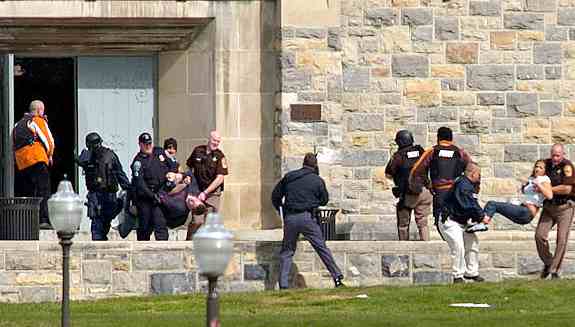
Virginia Tech
student victim evacuation
A
- Z of Sussex officer investigations
Ken
Jones
Paul
Whitehouse
The
above is just a few of a number of persons likely to be investigated in
respect of certain cases brought against Wealden Action Group members, on
the instigation of known Masons, councillors, or planning officers, many
of which are themselves Masons.
CONVICTION
QUASHED OVER 'MADE UP' VAMPIRE CLAIM
Paul Lewis - Friday May 19, 2006
The Guardian
A
man who was sentenced to eight years in prison in 2004 after a teenager
falsely alleged he repeatedly raped her in "vampire" rituals had
his conviction quashed yesterday.
Leon
Benjamin Forde, 21, of Lincoln, was jailed 18 months ago after the girl
claimed he subjected her to a sex ordeal two years previously, when she
was 13. But he won his freedom at the appeal court after the prosecution
accepted the girl's testimony was undermined by evidence uncovered from a
computer diary which suggested she had "made it all up".
Mr
Forde later said his time in prison had been "hell".
TEACHER
CLEARED OF RAPE TOO LATE
Graeme Paton - Published: 21 April 2006
A teacher who died in prison after being convicted of raping one of his
pupils has been posthumously cleared by the Court of Appeal.
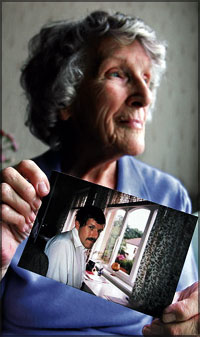
Molly Gee, 88, who has
been awarded £62,493 by the appeal court
after
battling to clear her son Darryl's name
Darryl Gee was jailed in 2001 despite scant evidence to corroborate his
accuser’s claims, which related to alleged incidents more than a decade
earlier.
The
music teacher, who protested his innocence, died in his cell from an
undiagnosed blood cancer. He had served 18 months of an eight-year
sentence.
This week, campaigners described the case as one of the worst miscarriages
of justice they had seen after the Court of Appeal in London quashed his
conviction.
It
comes as government guidance designed to speed up investigations into
alleged abuse of pupils is introduced in schools. Unions say this will
reduce the risk of innocent teachers being smeared by false allegations.
Chris
Keates, general secretary of the NASUWT, said: “This is an extreme and
tragic illustration of the consequences of malicious allegations and
underlines the need for these new procedures.”
Mr
Gee’s 88-year-old mother, Molly, awarded £62,493 costs by the court,
said the case should be a warning to other teachers.
“It
all boiled down to one girl’s word against his, and the jury believed
her,” she said. “That’s all it took to send my son to prison and it
has left me very angry and grief stricken. I don’t think anyone should
have to work alone with a child – it is just too easy for an allegation
like this to be made.”
Mr
Gee, a supply teacher who taught brass instruments, was found guilty at
Leeds crown court in January 2001 after being accused of raping and
indecently assaulting a pupil in a Huddersfield school in 1989. He died
aged 55 in August 2002, a month after a second appeal failed.
His
conviction was eventually quashed when his mother alerted the Criminal
Cases Review Commission, which asked a leading psychiatrist to report on
his accuser. The study cast doubt on her mental state. It also emerged
that the girl, now 26, made similar allegations against another man, whose
conviction was quashed earlier this year.
Read more in the TES including the story of
Charlie King. A jury took just half an hour to find him not guilty of
sexually assaulting three of his pupils. So why did it take 13 months for
the case to reach court?
SEX
ATTACK LIAR NAMED BY PEER
- 19th October 2006 by
SAM GREENHILL
A
woman with a long history of crying rape who sent an innocent man to jail
was named in Parliament amid calls for a change in the law.
Shannon
Taylor was unmasked by a peer who told the House of Lords her lies had put
father-of-two Warren Blackwell behind bars for more than three years.
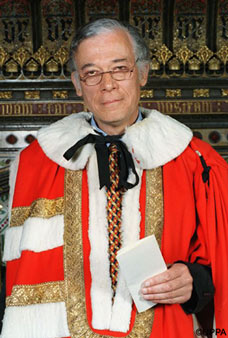
Lord
Campbell-Savours
Lord
Campbell-Savours used Parliamentary privilege to expose her identity and
lambast the 'shabby' police investigation that saw Mr Blackwell
imprisoned.
Legal
experts praised his decision to speak out to prevent other men falling
victim to fake sex attack allegations.
Mr
Blackwell, 36, whose loyal wife Tanya never doubted his innocence, was
dramatically cleared at the Appeal Court last month after Miss Taylor's
background as a serial fantasist was exposed by a Criminal Cases Review
Commission investigation.
But
although his name was blackened, anonymity laws meant his accuser's was
automatically protected, and she became known only as Miss A.
Even
the appeal judges wanted to name her - but were powerless to do so - to
warn other blameless members of the public.
The
Daily Mail led calls for her identity to be revealed before she put
another innocent man through torment.
Yesterday,
Lord Campbell-Savours - said to be motivated by 'outrage' at the case -
stood up and publicly did so.
He
asked fellow peers: "Is not the inevitable consequence of the
workings of the law, as currently framed, that we will carry on
imprisoning innocent people like Warren Blackwell, who was falsely accused
by a serial and repeated liar, Shannon Taylor, with a history of false
accusations and multiple identities?
"As
a result of her accusations, he spent three and a half years in prison
following a shabby and inadequate police investigation, and was only
exonerated when the Criminal Cases Review Commission inquiry cleared him
and exposed her history."
The
Labour peer added: "Shouldn't mature accusers who perjure themselves
in rape trials be named and prosecuted for perjury?"
Miss
Taylor's own daughter backed the decision to disclose her name, saying:
"She is a danger and the public needs to be warned. She needs
prosecuting for what she did. She is every man's worst nightmare."
Mr
Blackwell's ordeal began when his accuser, now 38, claimed she had been
seized with a knife outside a village club early on New Year's Day 1999,
taken to an alley and indecently assaulted.
She
later picked him out of an identity parade and a jury found him guilty,
even though there was no forensic evidence against him and he had no
previous convictions.
Eventually,
the case was investigated by the Criminal Cases Review Commission which
found that the woman had made up at least seven other fake allegations of
sexual and physical assault, including against her own father. She
frequently changed her name and police forces did not realise they were
dealing with the same woman.
Her
own mother has described her as "a persistent liar, very manipulative
and a bully" who frequently claimed to have been beaten, sexually
attacked and raped - all of which were untrue. She has a history of mental
illness and self-harm.
The
original investigation by Northamptonshire Police was exposed as shoddy,
with Mr Blackwell's lawyers claiming that normal safeguards and procedures
were completely ignored. He plans to sue.
Yesterday,
a friend of 63-year-old Lord Campbell-Savours explained why he decided to
speak out. He said: "He named
her because he was outraged. He doesn't think it's got anything to do with
the issue of rape, he thinks it's an issue of perjury.
"This
woman made up the story and told lies and he can't see why a person who
has perjured themselves should be protected, irrespective of the type of
offence.
"Sometimes
people have to stick their heads above the parapet in cases where the law
is clearly an ass and needs to be reformed.
"He
thinks the law around anonymity,
particularly where false accusations have been made, needs to be
changed."
Welcoming
the development, Mr Blackwell, from Woodford Halse, Northamptonshire,
said: "It's absolutely fantastic. I didn't think anybody would have
the guts to name her.
"This
woman needs to be stopped. The fact is, she remains free to carry on
crying rape and up till now has been enjoying the full protection of the
law. It's absolutely crazy that she could not be named and shamed, because
innocent men need to be warned to avoid her like the plague.
"Now
I hope she will go on to be prosecuted." But she is unlikely to face
charges for perjury or perverting justice.
Northamptonshire
Police yesterday claimed there was "insufficient evidence",
while Crown Prosecution sources have cited her mental illness as a
barrier.
But
Mr Blackwell's barrister Anne Johnson said: "There is a clear public
interest in her being prosecuted for perjury or the very least wasting
police time.
"It's
fantastic that somebody of authority has finally come out and named this
woman. The issue needs to be aired otherwise nothing will be done."
At
Mr Blackwell's appeal last month, Mr Justice Tugendhat admitted that
similar tragic cases could follow because of the lies of the 'Miss A',
adding that Parliament had not seemed to have considered this possibility
when framing the law. Last night the judge said he did not wish to comment
on yesterday's twist.
In
the 1970s, the Daily Mail campaigned for women in sex cases to be granted
automatic anonymity, to protect genuine victims of genuine crimes.
Although Miss Taylor has now been publicly named, there is nothing to stop
her changing her identity yet again.
Callers
to her most recent address were told by her boyfriend that she no longer
lived there.
Here's
what readers have had to say so far. Why not add your thoughts below?
It
is unfortunate that in my opinion women seem to be able to make
allegations and men are treated as guilty unless proven innocent. This
spills over into family law where this happens all the time. It is time
for laws to be changed and the system to be exposed for what it is. I
take my hat of to the judge for naming this women. It is about time that
more professional people i.e. judges and lawyers started looking at what
is right and wrong instead of either following there own political
agenda or lining their own pockets.
- Lisa Lipscombe, Burlington, Canada
The
sentencing for false accusations of rape should be as harsh, and
enforced as harshly, as rape itself.
The USA also needs to wake up to the many false allegations of rape that
are putting innocent men in jail.
- Denis, Boston, MA USA
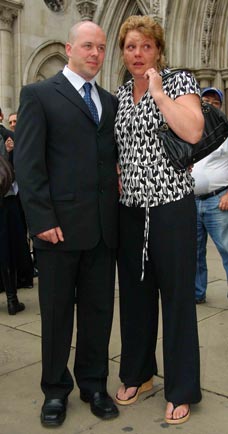
Warren
Blackwell and wife Tanya - Guilty until Proven Innocent
Man
freed but serial rape accuser remains anonymous -12th
September 2006
Warren
Blackwell and his wife Tanya outside the Court of Appeal
An
innocent man jailed for a sex attack was dramatically cleared after it
emerged that his 'victim' is a serial liar with a long history of crying
rape.
But
because of laws that protect her anonymity, judges are powerless to name
and shame her, leaving her free to make more false accusations against
blameless members of the public.
Mr
Blackwell, 36, hugged his loyal wife Tanya and wept as the Appeal Court
quashed his conviction.
He
described his accuser as "every man's worst nightmare".
Mr
Justice Tugendhat admitted, however, that similar tragic cases could
follow because of the lies of the woman, Miss A.
"Parliament
does not seem to have contemplated this situation.
"There
appears to be no means of displacing her entitlement to anonymity."
In
the 1970s, the Daily Mail campaigned for women in sex cases to be
granted automatic anonymity, but now there are questions about whether the
law has gone too far.
Warren
Blackwell's nightmare began when Miss A, now 38, claimed she had been
seized with a knife outside a village club early on New Year's Day 1999,
taken to an alley and indecently assaulted.
She
later picked Mr Blackwell out at an identity parade.
There
was no forensic evidence against him and he had no previous convictions.
'She
needs to be stopped'
Yet
Mr Blackwell, from Woodford Halse, Northamptonshire, was found guilty and
spent three years and four months behind bars.
Eventually
the case was referred to the Criminal Cases Review Commission (CCRC) which
assigned Detective Chief Inspector Steve Glover, to investigate. He
discovered that the woman:
• Has made at least five other fake allegations of sexual and physical
assault to police in three separate forces.
• Was married twice and made false allegations against both husbands -
one of whom was a policeman.
• Once accused her own father of sexual assault, but police concluded
she had made it up.
• Accused a boy of rape when she was a teenager, only for a doctor to
discover she was still a virgin.
• The CCRC concluded that in the case of Mr Blackwell, she had
"lied about the assault and was not attacked at all, her injuries
being self-inflicted".
The
Crown Prosecution Service did not oppose the appeal.
David
Farrell QC, for the Crown, said: "This conviction is unsafe. What has
come out of the woodwork paints a picture of a woman with immense personal
problems with serious difficulties in distinguishing between truth and
lies."
If
this information had been known at the time of the trial, he added,
"this case would not have made it off the ground".
Mr
Blackwell said: "Clearly something has to be done about this woman.
She needs to be stopped. The prosecution say she is psychiatrically
disturbed, but insane people who murder are tried and if found guilty put
away."
Mr
Blackwell, who plans to sue police over his ordeal, will now have his name
removed from the Sex Offender Register.
His
accuser has a history of mental illness and self-harm - once inscribing
the word 'HATE' on her body with scissors.
However,
because she has changed her name at least eight times, and moved between
addresses in at least three counties, it seems police never realised they
were dealing with the same woman.
For
Mr Blackwell, her accusations meant he missed more than three years of
family life. His son Liam, ten, and stepdaughter Holly, 16, were three and
nine when his ordeal began.
His
36-year-old wife said: "I never doubted him for a second. We were
together six years before it happened, and ever since."
By
SAM GREENHILL
F.A.C.T.
(Falsely Accused Carers and Teachers)
PO Box 3074
Cardiff CF3 3WZ
Tel: 029 2077 7499
E-mail: info@factuk.org
Website: www.factuk.org
Campaigning organisation and support group which provides help and advice
to falsely accused and wrongly convicted carers and teachers throughout
the UK. The website contains a range of information, leaflets, books and
links.
Guidance
for education staff and volunteers in schools
Website: www.lg-employers.gov.uk/conditions/education/allegations
This website has guidance on: 1) staff facing an allegation of abuse; 2)
preventing 'abuse of trust' for education staff; and 3) the conduct of
education staff working with young people.
LINKS
and REFERENCE
30
Sep 99 Americas - Gunmaker
can be sued over shooting
11 May 99 Americas - Charge
over Columbine gun
22 Apr 99 Americas - Massacre
'could have been prevented'
21 Apr 99 Americas - Denver
massacre reignites gun debate
21 Apr 99 Americas - Timetable
of terror
National
Centre Educational Statistics: Violence & Discipline Problems US
Schools
Columbine High School
Information Centre
The
Miscarriages of Justice Organisation
'Bringing hope to the innocent'
MOJO
Scotland
The
millioncampaignhomepage is inspired by the Million Dollar Homepage,
run by a 21 year old student and entrepreneur called Alex Tew.
Mr.Tew's website was phenomenally successful and his vision of the
website mosaic will revolutionise the way internet space is organised.
As well as being a brilliant concept, the website he created looks
like an internet version of Piet Mondrian's depiction of the vibrancy
of jazz era New York.
We here at the Million Campaign Homepage believe that the world, and
particularly the mainstream media, is already flooded with
advertising. In the era of global warming we need to evolve to a
global public service instead of local private profit. We have a
planet to save, and a life upon it to safeguard and secure for future
generations - animal, vegetable, and mineral.
There is a lot of cynicism in the world and people feel that their
actions are incapable of making positive change. That disillusionment
is inaccurate. The power of synergy and symbiosis is enormous. The
more bridges are built between different campaigns, the less
duplication results. Achievement grows exponentially. River flows move
mountains, volcanoes erupt from the steady accumulation of magma, and
oceans develop from the confluence of small streams.
The Million Campaign Homepage is an ecosystem where a congregation of
campaign groups can co-exist together. Instead of the competitive
principle, where one individual or group profits at the expense of
another, we believe in the co-operative principle where the health and
prosperity of one is directly correlated to the health and prosperity
of others.
The Million Campaign Homepage is a links page. It is a mosaic. It is a
library. It is a jigsaw puzzle. It is a space-station where social
entrepreneurs can dock their spaceships. The sum of the whole is
greater than its parts. Keep the information flowing and the networks
growing - please add your tile to the game by contacting us.
MillionCampaignHomepage
Open
forum where we have added Simon’s case for discussions / questions.
True
Crime, World News and Justice: For Readers and Writers
The
National Monthly Newspaper for prisoners
Inside
Time
we
have created a page on Myspace for Simon, again, to raise awareness.
My
Space
This
is a News Website, allowing people to post their own stories, if you
search for Simon Hall, you will see our articles on there, this will
hopefully bring even more awareness to the campaign and who knows who
might pick this it up. The more views we get on our articles, the more
popular our story becomes and the more chances we have of being
noticed and bringing Simon home.
Now
Public
To
raise public awareness of wrongful convictions as a continuing cause
for concern, despite the creation of the Criminal Cases Review
Commission.
To facilitate research that identifies the causes of wrongful
convictions in the interests of effecting legal reform to reduce the
occurrence of wrongful convictions.
To encourage the establishment of Innocence Projects within
universities in the UK.
Innocence
Network UK
Guidance
Note 10, Improving Prison Healthcare. Duty of care for prisoners:-
"All persons deprived of their liberty shall be treated with
humanity and with respect for the inherent dignity of the human
person."
Improving
Prison Healthcare
The
perfect guide to get you started.
Who to contact, where to go, support is available, you just need to
ask!!!
Visit United Against Injustice (Thanks to Andrew, great drop menu :)
No
Smoke Without Fire
The
Prisons and Probation Ombudsman is appointed by the Home Secretary and
investigates complaints from prisoners and those subject to probation
supervision, or those upon whom reports have been written. The
Ombudsman is completely independent of both the Prison Service and the
National Probation Service (NPS). The current Ombudsman is Stephen
Shaw, and a team of deputies, assistants, investigators and other
staff supports him.
The
Prisons and Probation Ombudsman
Judge
for Yourself is a book that is long overdue - a well researched lay
person's guide to the British legal system's appalling number of
miscarriages of justice.
Naylor starts from an intelligent and irrefutable premise: that any
system of justice, being man made, is prone to error.
L.A.
Naylor Judge for yourself
Independent
Police Complaints Commission
IPCC
All-party,
Law Reform and Human Rights organisation working to improve the legal
system and the quality of justice.
Liberty
4th National Miscarriage of Justice Day Public Meeting.
Raising the Profile of Miscarriage of Justice.
We will be there to represent our campaign, for more information click
on the link...
MISCARRIAGE
OF JUSTICE DAY
The
Parole Board is the independant body that protects the public by
making risk assessments about prisoners to decide who may safely be
released into the community and who must remain in or be returned to
custody...
The
Parole Board
Organisation
helping people through Miscarriages of Justice
Portia
Organisation
helping people through Miscarriages of Justice
United
Against Injustice
Miscarriages
Of Justice UK, another organisation supporting miscarriages of
justice.
www.mojuk.org.uk
Criminal
Case Review Commission
www.ccrc.gov.uk
Manchester
based organisation supporting people going through miscarriages of
justice. Special THANX to Ann!
www.innocent.org.uk
This site is protected under
Article10 of the
European Convention on Human
Rights and Fundamental Freedoms.
FAIR
USE NOTICE
This
site contains copyrighted material the use of which has not always been
specifically authorized by the copyright owner. We are making such
material available in our efforts to advance understanding of
environmental, political, human rights, economic, scientific, and social
justice issues, etc. We believe this constitutes a 'fair use' of any such
copyrighted material as provided for in section 107 of the US Copyright
Law. In accordance with Title 17 U.S.C. Section 107, the material on this
site is distributed without profit to those who have expressed a prior
interest in receiving the included information for research and
educational purposes.
For
more information go to: http://www.law.cornell.edu/uscode/17/107.shtml. If
you wish to use copyrighted material from this site for purposes of your
own that go beyond 'fair use', you must obtain permission from the
copyright owner.
|