|
GYPSY CARAVANS & ENFORCMENT
|
|||
|
AFFORDABLE HOMES
We all need somewhere to live that we can afford. Previous governments have done little to balance the system and for the most part councils were given a free reign to empire build, competing against other counties for prestige - rather than catering for the ordinary man and thinking about the planet.
That explains all the heavy handed enforcement. Because, in order to preserve high prices in their areas, and plentiful backhanders too boot, one has to stop ordinary folk from trying to live economically - which, as it happens is also living ecologically.
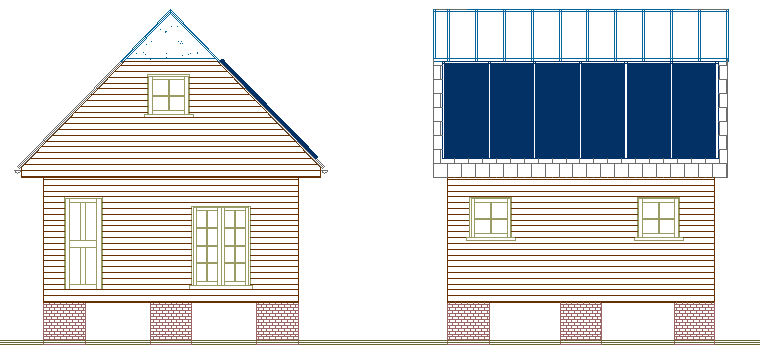
The Utopia Tristar RE flat-pack, a 20' x 18' home complying with the Caravans Act, also being zero carbon rated, if assembled correctly according to the supplied specifications. Utopia flatpacks start at £25,000 for a basic specification. If you already have permission for a caravan on site, you won't need to apply again. The design shown features a solar conservatory and PV panels, which cost extra. Email: homes@cherrymortgages.com for a no obligation chat about your options. We also have an in-house planning strategist, who obtained our first consent for a design similar to the above, except three times the size.
DEBATE
The
discourse about Gypsy and Traveller communities has a long and
well-established history. An integral element has been the unresolved
tension between the experiences of Traveller and settled communities,
and the relationship between these communities and the state. These
experiences are replicated across England and Wales, with recent media
attention focused on examples in Bournemouth, Bedfordshire,
Gloucestershire, Monmouthshire and the London Borough of Newham. The
Office of the Deputy Prime Minister (ODPM) is currently consulting on
strategies for managing unauthorised encampments, and the Department of
the Environment, Food and Rural Affairs (DEFRA) has just published
proposals for the regulation and governance of public spaces. The
implementation of the new duties on public bodies to promote community
relations and race equality under the Race Relations Amendment Act in
May 2002 will also have a bearing on the delivery of goods and services
to the Gypsy and Traveller communities. THE MAIN ISSUES the needs, experiences and rights of Gypsy and Traveller communities, particularly in relation to accommodation and economic activity, on the one hand, and the responsibilities and duties of local authorities in promoting economic, environmental and social well-being, encouraging and providing for community safety and community cohesion, promoting race relations and responding to (and managing) the demands of the local electorate on the other. HISTORY
Gypsies have been travelling the roads of Britain for hundreds of years, but now only one in 10 Romanies spend their lives on the move. Hannah Satterthwaite talks to John and Linda Porter about what the future holds for their community.
BY the age of nine John Porter was at work with his father, collecting scrap and doing odd jobs. He was married to his childhood sweetheart at 14, by which time the family had relocated more times than he can remember. Born in a Gypsy wagon in the tiny village of Newton in the Willows in Lincolnshire, John’s childhood is not unusual for a Romany traveller. “We had to start work young,” he said. “That was the only way to survive. We started as kids and never stopped.”
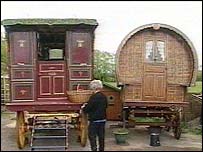
Traditional Gypsy Caravans
Gypsy leader charges dropped 15 Apr 03 | North Yorkshire Gypsies say council is racist 04 Apr 03 | England Award for gypsy leader 24 Mar 03 | England Legal action to remove gypsies delayed 19 Mar 03 | England Gypsy leader gets UN role 18 Jan 03 | England
More Gypsy Voices
Gypsies are thought to have arrived on English soil about 400 years ago. Researchers believe they left the Indus valley in northern India in the ninth century and travelled through Persia, reaching eastern Europe about 1,000 years ago. Their language contains Sanskrit, along with parts of the Greek, Romanian and other languages. They have historically moved around the UK, taking up seasonal work such as fruit- and flower-picking. Travellers say one of the main reasons for conflict between their community and the sedentary one is that British society does not recognise the right to a nomadic way of life.
Many non-Gypsies know little more about Gypsy culture than quaintly painted wagons and women who wear large gold-hooped earrings - although many Gypsies have neither. Although there are an estimated 42,000 Gypsy traveller children in England, they have been very much a poor relation in terms of receiving specialist support in schools and in terms of the recognition of their culture within the curriculum. As long ago as 1967, the Plowden reports acknowledged the specific needs of Gypsy traveller children, stating that: "the children's educational needs are . . . extreme and largely unmet . . . They will require special attention and carefully planned action."
HMI reports in 1996 and 1999 raised concerns about the level of attainment of Gypsy traveller pupils, particularly at secondary school level, where attendance rates are lower than at primary school. "In all schools where information was available, over 50% of the Gypsy traveller population were on the SEN [special educational needs] register, and in one school it was 80%. In half the schools, no Gypsy traveller child has yet sat for GCSE," says the 1999 HMI report, Raising the Achievement of Minority Ethnic Pupils.
Voices: The Gypsy's Horse is on Radio 4 at 11.30pm on Friday August 22. The Voices website is at www.bbc.co.uk/kent/voices/ Aiming high: raising the achievement of gypsy traveller pupils - a guide to good practice is available by emailing dfes@prolog.uk.com or calling 0845 6022260. Accessing Council Services and Information The Disability Discrimination Act Equality and Diversity, Black Minority Ethnic Community Contact List Gypsies ,Travellers and Unauthorised Camping History Of English Gypsy Travellers Racist Incidents and Hate Crime Race Relations (Amendment) Act 2000 (RRAA)
Gypsy
Collections - Gypsy wagons
Gipsy
Caravan
Horse
Drawn Gypsy Caravans Holidays, Building and Restoration
Gypsy-Vardo.com
- Restoring a Gypsy Vardo Caravan
Gypsy
wagon traveller for sale
Gypsy
Caravan Building, Restoration and Painting
Horse
Drawn Gypsy Caravan Holidays, Wiltshire
Gypsy-Vardo.com
- Restoring a Gypsy Vardo Caravan
BBC
NEWS | Wales | Mid Wales | Respects paid as caravan burns
The
Observer | Special reports | A burning issue in the village
http://www.bltm/epona/index.htm Build your own wagon - project story and pictures.
THANKS
I would just like to say to the growing number of affected members of the public who telephone or email me, that I am so very pleased if anything we have published can be used to further just decision making. The encouragement is mutual! Lastly, if you cannot find what you are looking for on these pages and need some help, please help me to help others by emailing first. Please reserve the telephone for emergencies only.
LINKS
This site is protected under Article10 of the European Convention on Human Rights and Fundamental Freedoms.
|
|||
| A-Z Index | Site Map | Contact Us | Help | |||
|
|