|
CONCRETE
HOME | A-Z INDEX | MEMBERS | MPS | OFFICERS HOME | AFFORDABLE | CLIMATE | DEVELOPERS | ECONOMY | FLOOD | HISTORY | HOMES LADDER | MORALS | POVERTY | PROPERTY | SLAVERY | TAXES | SLUMS | VALUATIONS | WEALTH
|
|
HISTORY
Cement has been around for at least 12 million years. When the earth itself was undergoing intense geologic changes natural, cement was being created. It was this natural cement that humans first put to use. Eventually, they discovered how to make cement from other materials.
Concrete is a compound material made from sand, gravel and cement. The cement is a mixture of various minerals which when mixed with water, hydrate and rapidly become hard binding the sand and gravel into a solid mass. The oldest known surviving concrete is to be found in the former Yugoslavia and was thought to have been laid in 5,600 BC using red lime as the cement.
The Assyrians and Babylonians used clay as the bonding substance or cement. The Egyptians used lime and gypsum cement. In 1756, British engineer, John Smeaton made the first modern concrete (hydraulic cement) by adding pebbles as a coarse aggregate and mixing powered brick into the cement. In 1824, English inventor, Joseph Aspdin invented Portland Cement, which has remained the dominant cement used in concrete production. Joseph Aspdin created the first true artificial cement by burning ground limestone and clay together. The burning process changed the chemical properties of the materials and Joseph Aspdin created a stronger cement than what using plain crushed limestone would produce.
The first major concrete users were the Egyptians in around 2,500 BC and the Romans from 300 BC The Romans found that by mixing a pink sand-like material which they obtained from Pozzuoli with their normal lime-based concretes they obtained a far stronger material. The pink sand turned out to be fine volcanic ash and they had inadvertently produced the first 'pozzolanic' cement. Pozzolana is any siliceous or siliceous and aluminous material which possesses little or no cementitious value in itself but will, if finely divided and mixed with water, chemically react with calcium hydroxide to form compounds with cementitious properties. The Romans made many developments in concrete technology including the use of lightweight aggregates as in the roof of the Pantheon, and embedded reinforcement in the form of bronze bars, although the difference in thermal expansion between the two materials produced problems of spalling. It is from the Roman words 'caementum' meaning a rough stone or chipping and 'concretus' meaning grown together or compounded, that we have obtained the names for these two now common materials.
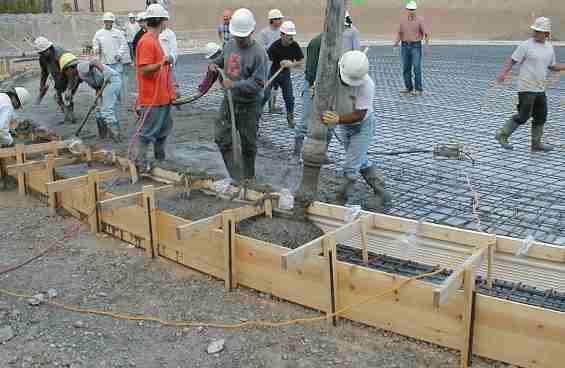
Building a Dam using steel reinforced concrete. Here, a pump is used to pour concrete from a giant mixer, typically mounted on the back of a truck. Construction workers then spread the concrete out and level it with rakes. Complex shapes can be formed with timber shuttering, as seen above to contain the pour.
Portland CementLime and Pozzolana concretes continued to be used intermittently for nearly two millennia before the next major development occurred in 1824 when Joseph Aspdin of Leeds took out a patent for the manufacture of Portland cement, so named because of its close resemblance to Portland stone. Aspdin's cement, made from a mixture of clay and limestone, which had been crushed and fired in a kiln, was an immediate success. Although many developments have since been made, the basic ingredients and processes of manufacture are the same today.
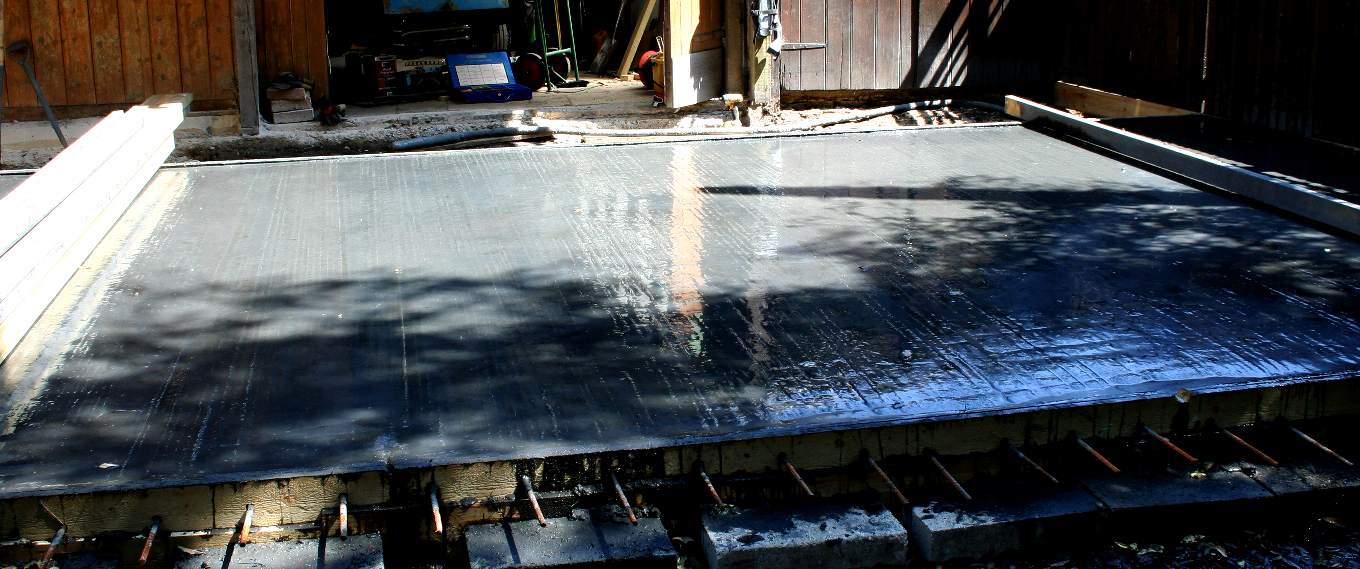
Pouring a drive using concrete C35 mix that is coloured with grey admix to be able to polish a drive up to a flat and pleasing finish.
Reinforcement
In
1830, a publication entitled, "The Encyclopaedia of Cottage, Farm
and Village Architecture" suggested that a lattice of iron rods
could be embedded in concrete to form a
roof. Eighteen years later, a French lawyer created a sensation by
building a boat from a frame of iron rods covered by a fine concrete
which he exhibited at the Paris Exhibition of 1855. Steel reinforced concrete
was now born. The man normally credited with its introduction as a
building material is William Wilkinson of Newcastle who applied for a
patent in 1854 for "improvement in the construction of fireproof dwellings, warehouses, other buildings and parts of the same".
It is not only fire resistance that is improved by the inclusion of steel in the concrete matrix. Concrete, although excellent in compression, performs poorly when in tension or flexure. By introducing a network of connected steel bars, the strength under tension is dramatically increased allowing long, unsupported runs of concrete to be produced. Steel and concrete complement each other in many ways. For example, they have similar coefficients of thermal expansion so preventing the problems the Romans had with bronze. Concrete also protects the steel, both physically and chemically.
Composition of Portland Cement Portland cement is a complex mix of many compounds, some of which play a major part in the hydration or chemical characteristics of the cement. It is manufactured commercially by heating together a mixture of limestone and clay up to a temperature of 1300 to 1500°C. Although twenty to thirty percent of the mix becomes molten during the process the majority of the reactions which take place are solid-state in nature and therefore liable to be slow. Once cooled, the resulting clinker is ground to a fine powder and a small amount of gypsum (calcium sulphate dihydrate) is added to slow down the rate at which the cement hydrates to a workable level.
The work of early investigators using optical and X-ray techniques, starting in 1882 with Le Chatelier, has shown that most Portland cement clinkers contain four principal compounds. These are tricalcium silicate (3CaO.SiO2), aluminate (3CaO.Al2O3) and a ferrite phase from the (2CaO.Fe2O3 - 6CaO.2Al2O3.Fe2O3) solid solution series that at one time was considered to have the fixed composition (4CaO.Al2O3.Fe2O3). These phases were named alite, belite, celite and felite respectively by Tornebohm in 1897.
Hydration of Portland CementWhen water is mixed with Portland cement a complicated set of reactions is initiated. The main strength giving compounds are the calcium silicates which react with water to produce a calcium silicate hydrate gel (C-S-H gel) which provides the strength, and calcium hydroxide which contributes to the alkalinity of the cement. Tricalcium silicate reacts quickly to provide high, early strengths while the reaction of dicalcium silicate is far slower, continuing, in some cases, for many years. The other cement compound of particular relevance to steel reinforced concrete is tricalcium aluminate. It reacts rapidly with water to produce calcium aluminate hydrates.
The
amount of tricalcium aluminate present may well be limited as in the
case of sulphate resisting Portland cement, to prevent adverse reactions
between the hydrate and sulphates from the environment which can result
in swelling and cracking of the cement matrix.
The great advantage of tricalcium aluminate is its ability to combine with chlorides, so removing them from the liquid phase of the cement. Chloride ions, as will be seen, are one of the major causes of corrosion of embedded steel.
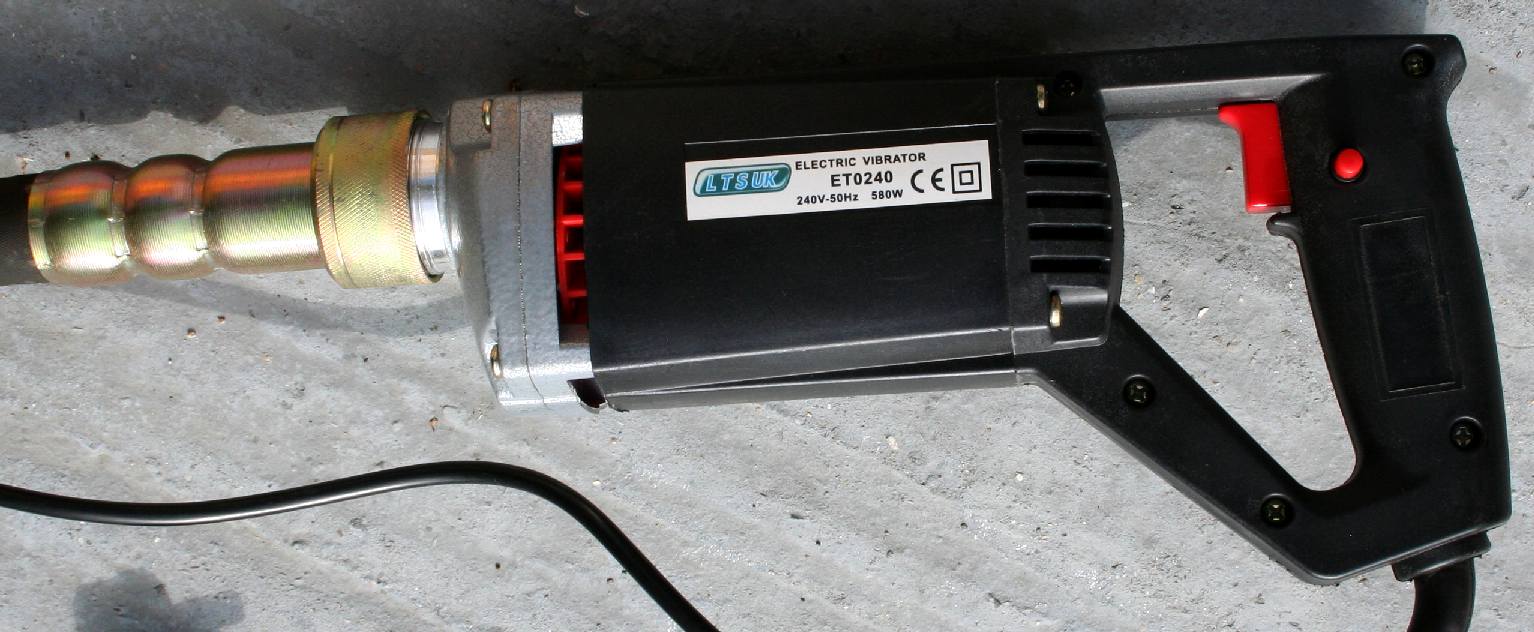
VIBRATOR - When pouring concrete that has to carry heavy loads, it is best to use some form of vibrator or compactor to strengthen the cured slab. You can buy these units reasonably cheaply from Ebay or Amazon or hire from you local builders merchants.
The machine above was supplied incomplete and possibly already a returned unit, where the flex of the main electric motor is covered in cement, when it was supposed to be an un-used product according to the advertised description.
Two out of three = nothing. What use is a motor without the vibrating hose to go with it. This is what was received by one customer from C Bury Sales Ltd in Blackburn, Lancashire. The order was placed via an Ebay advertisement on the telephone. The lady working for Chris Bury said the items (all of the package) would be with the customer within 3 or 4 days. Sadly, one item was missing; the 4 meter hose and head, meaning that the motor unit was useless.
After more than two weeks TNT were contacted and confirmed that they'd not delivered three packages, only two being scanned in. That appeared to mean that TNT had not been given a third package of a three package consignment. Before the customer found this out the supplier was able to make vague replies that tended to suggest that they were not at fault. This is a cavalier approach to dealing with customers who are entitled to rely of information as to delivery times given verbally - if that is a factor in any project - as it was in this case.
SCREEN SNAPSHOT - On the 10th of June 2018, this trader was still advertising the 240volt high frequency concrete vibrator for sale with 2-3 day delivery, even though he'd been unable to supply the 4 meter hose to a customer from an order some 20 days before. Sounds to us like a matter for trading standards and Ebay, who are supposed to make sure that traders perform, or otherwise rank them lower, or ban them from selling using online. The snapshot is evidence for any claim, should anyone else have experienced difficulty with Chris Bury Sales of Blackburn:
C Bury Sales Ltd
GENERAL RULE - Be very careful when dealing with internet suppliers who may be having a bad day. There are dozens of traders out there all jostling to make a business based on prompt supply and keen prices. With carriers in the chain who might be blamed by rogue traders for their mistakes, it is complicated to get someone to admit a mistake and even more of a bind to recover the monies expended on dodgy items.
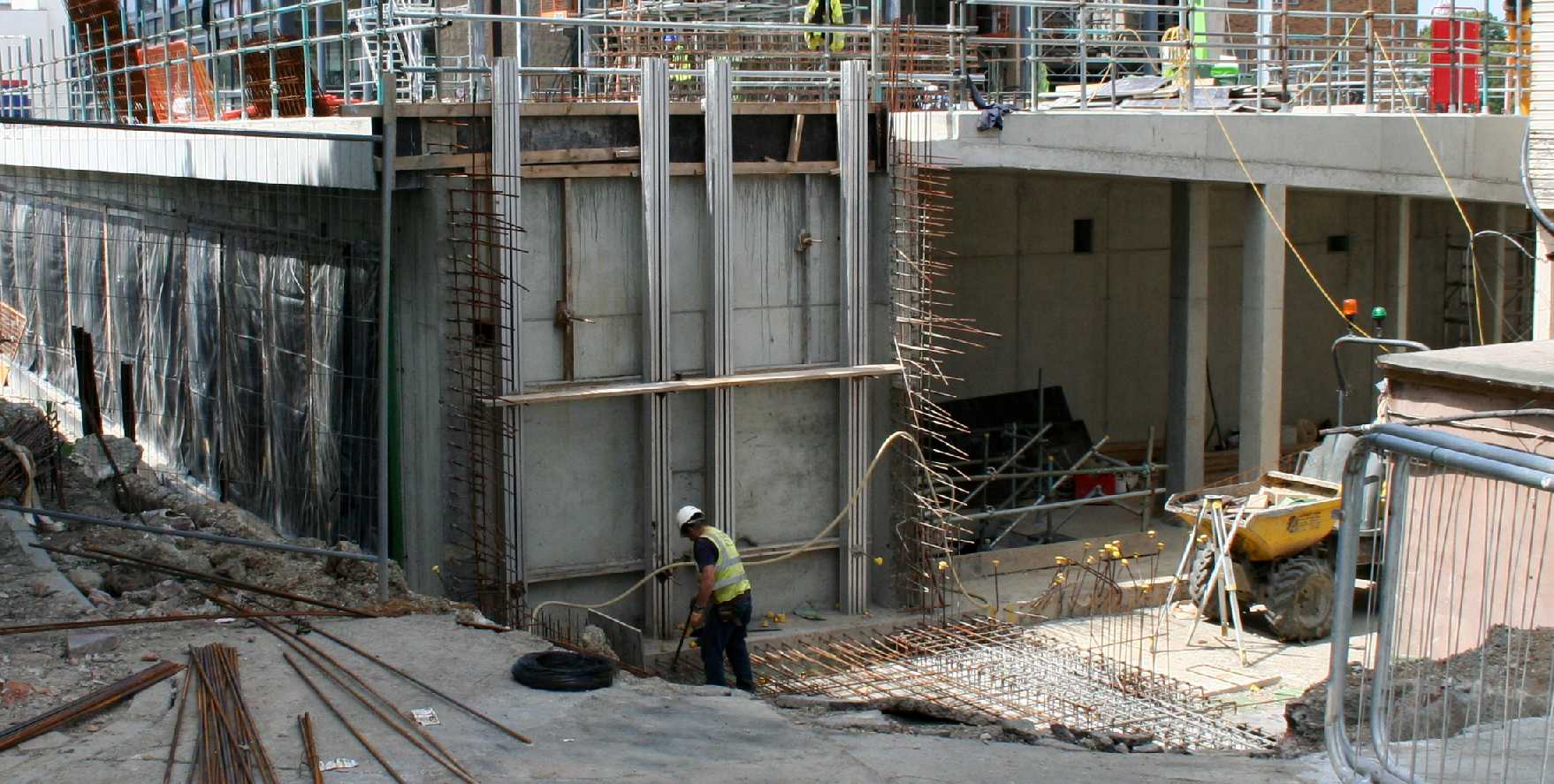
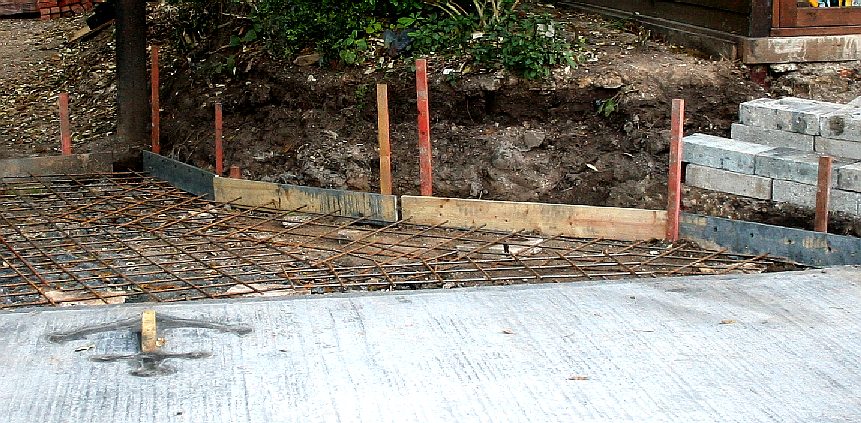
Steel reinforcing mesh is inserted before the concrete pour to strengthen a drive that may have to carry heavier than normal loads from trucks. The base is ideal to build a retaining wall from bricks.
Concrete that includes imbedded metal (usually steel) is called reinforced concrete or ferroconcrete. Reinforced concrete was invented (1849) by Joseph Monier, who received a patent in 1867. Joseph Monier was a Parisian gardener who made garden pots and tubs of concrete reinforced with an iron mesh. Reinforced concrete combines the tensile or bendable strength of metal and the compressional strength of concrete to withstand heavy loads. Joseph Monier exhibited his invention at the Paris Exposition of 1867. Besides his pots and tubs, Joseph Monier promoted reinforced concrete for use in railway ties, pipes, floors, arches, and bridges.
History of Structural Concrete Case Studies
Related Information
Wolf Hilbertz, German architect and inventor is the father of sea-creation, the electrolytic deposition of sea-shell-like minerals from seawater that creates a construction material. Patented on January the 20th, 1981.
LINKS & REFERENCE
https://www.ebay.co.uk/itm/HIGH-FREQUENCY-CONCRETE-VIBRATING-POKER-240-VOLT-new-INCS-FREE-POKER/382485060136
POKER - This hand held unit from Chris Bury, trading as MachineReturns or Local Tool Sales, worked intermittently. Mostly when switching on the head, the end of the one meter hose did not vibrate. Then for no reason it would kick in and out again of high frequency vibrating mode. The goods are thus faulty by the looks of it. We are interested to learn of the explanation for this. What is this high-frequency poker supposed to perform like and is this a machine that had been returned before as being faulty?
COMMENT
It is essential to provide housing at affordable prices for every person in the United Kingdom. At present house prices are kept artificially high. For this reason life is so much harder for young couples starting out that it is almost impossible to break free of the renting cycle - making them financial slaves for the rest of their lives.
This seems to be the British way, where the older and wealthier citizens are allowed, even encouraged by the Government to prey on the young. When the opposite should hold sway in a Britain that is fair and decent to live in. But, we do not have a constitution and our planners are allowed to behave like Gestapo officers in the way they work to keep the young restrained and the rich in power.
Part of the reason houses are so expensive, is that the planning officers employed by town councils are not accountable to the ratepayer. MANY ARE ON THE TAKE and in property development themselves - or will leave their council and work as a consultant in their own practice having learned the ropes and made all the contacts they need to go it alone. In addition, councillors are usually retired or well off, or perhaps do not need to work and some are landlords or are related to building firms.
Instead of worrying about providing housing for the man in the street, they simply want to make their empire worth more and the way to do this is to encourage the build of more expensive houses that attract higher rates to generate more income for the council. Hence, we have a plethora of expensive houses and no affordable housing stocks.
It stands to reason. If you had the chance to make your property worth more, what would you do? Whatever the reason, councillors do not argue against some planning applications, but will argue against other identical proposals if it suits their officers.
The opposite is also true. Some planning applications are approved before they hit the committee room. While other applications more in line with good planning policy, get a rough ride - delays - questions and requests for more details.
It really all depends on who is making the application. If you are not on the list of friends and associates, you stand much less of a chance of obtaining planning permission.
THIS SITE CONTAINS MANY EXAMPLES OF COUNCIL'S UNREASONABLE BEHAVIOUR - With thanks to Action Groups across the country for the supply of real case history and supporting documents. *THAT THE PUBLIC MAY KNOW*
|
|
This site is free of © Copyright except where specifically stated. Any person may download, use and quote any reference or any link, and is guaranteed such right to freedom of information and speech under the Human Rights and Freedom of Information Acts. However, be aware that we cannot be held liable for the accuracy of the information provided. All users should therefore research matters for themselves and seek their own legal advice and this information is provided simply by way of a guide. Horse Sanctuary UK Limited.
|